Your shoppers grew up with Google. They use Siri and Alexa daily. They search Amazon hundreds of times a year. They have been trained - by the best technology companies on Earth - to expect search that understands them.
Then they come to your ecommerce store, type something perfectly reasonable into your search bar, and get results that look like they came from 2008.
The gap between what shoppers expect from site search and what most stores deliver isn't a small UX issue. It's a chasm. And every day, customers fall into it and never come back.
Let's look at what the research actually says.
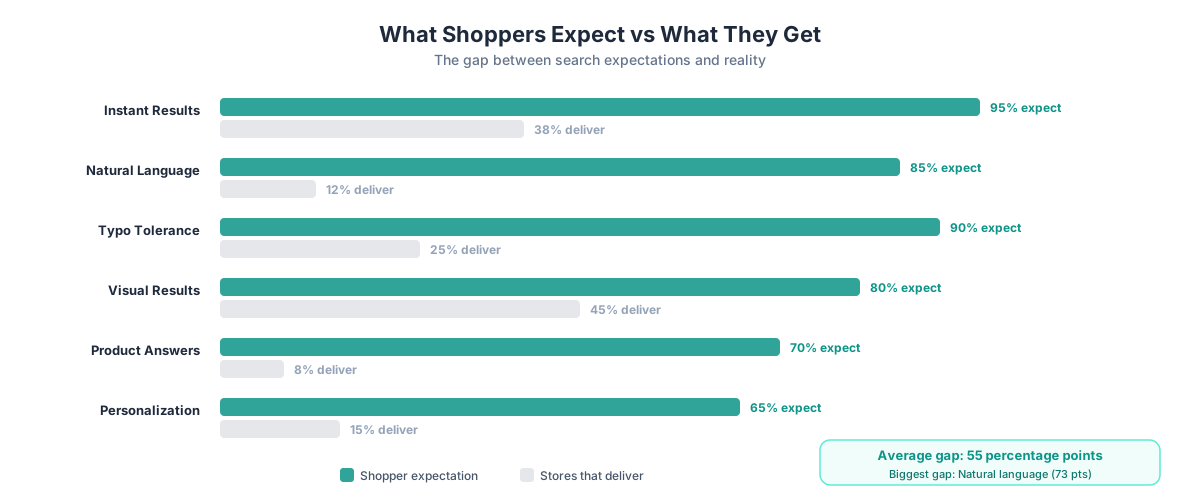
!Expectation vs reality gap chart
What Shoppers Expect: The Research
Across multiple studies - Baymard Institute's ecommerce UX research, behavioral analytics from major ecommerce platforms, and consumer survey data - a clear picture emerges of what online shoppers consider table stakes for site search in 2026.
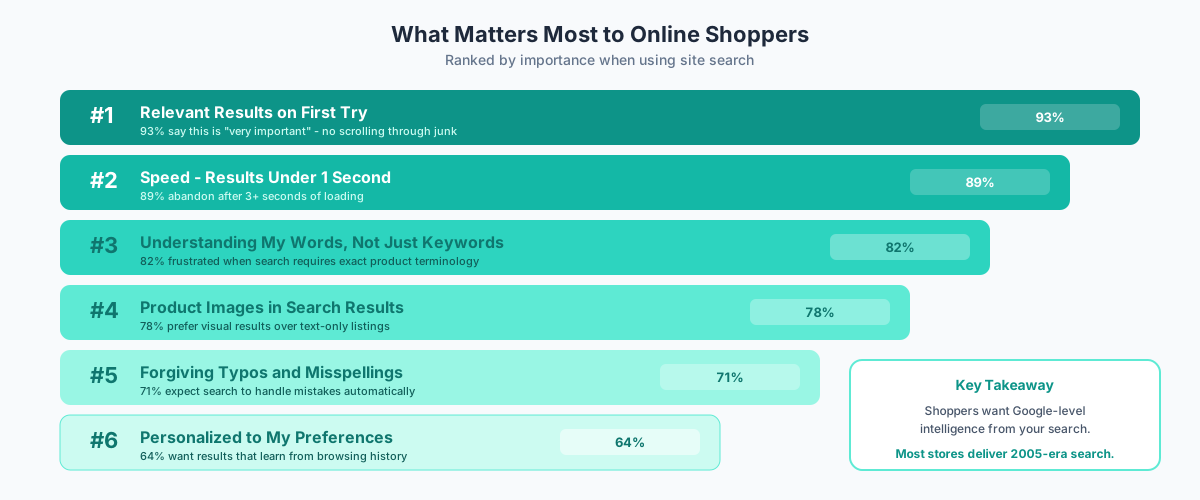
1. Relevant Results on the First Try (93% expect this)
This is the big one. Shoppers overwhelmingly expect that their first search attempt should return useful products. Not ten pages of loosely related items. Not "did you mean?" suggestions. Actual relevant results.
The reality? Most ecommerce search engines return results based on keyword matching, which means the quality is entirely dependent on whether the shopper happens to use the same words as your product catalog. If they search "couch" and your products are tagged "sofa," they get nothing useful.
The gap: 93% expect relevance on first try. Roughly 38% of stores consistently deliver it.
2. Natural Language Understanding (85% expect this)
Shoppers want to search the way they talk and think. "Comfortable shoes for standing all day at work." "Gift for my mom who likes gardening." "Something waterproof for hiking in the rain."
These are perfectly clear descriptions of what they need. A human sales associate would understand immediately. But most site search engines? They try to match "comfortable," "shoes," "standing," "all," "day," "at," "work" as individual keywords and return a mess.
The gap: 85% expect natural language search. Only about 12% of ecommerce sites handle it well. This is the single biggest gap in the entire study.
3. Typo Tolerance (90% expect this)
Mobile shopping now accounts for more than 60% of ecommerce traffic. People are typing on small screens, often with one hand, while walking or commuting. Typos are inevitable. "Sneakrs" should return sneakers. "Lavendar" should return lavender products. "Wireles earbuds" should return wireless earbuds.
Baymard research found that roughly one in ten search queries contains typos. That's 10% of your highest-value visitors who are one keystroke away from a dead end.
The gap: 90% expect typo tolerance. Only about 25% of stores handle it well.
4. Visual Results (80% expect this)
When shoppers search, they want to see products - not text links. Product images, prices, ratings, and availability should appear directly in search results. This seems obvious, but a surprising number of ecommerce sites still show text-heavy result pages that require clicking through to see what products actually look like.
The gap: 80% expect visual results. About 45% of stores deliver them adequately. This gap is narrowing as platforms improve their defaults, but many stores still use outdated search result templates.
5. Instant Product Answers (70% expect this)
Increasingly, shoppers don't just want to find products - they want answers. "Is this dishwasher safe?" "What size should I get for a 5-year-old?" "Does this come in green?" They expect search to understand questions and surface answers directly, not just return a product list.
The gap: 70% expect product answers. Only about 8% of stores can answer product questions through search. This is a massive opportunity.
6. Personalization (65% expect this)
Shoppers who return to your store expect search to remember context. If they previously bought men's clothing, a search for "shirts" should probably default to men's shirts. If they browse in the $50-100 range, results should prioritize that price band.
The gap: 65% expect personalization. About 15% of stores deliver meaningful search personalization. Most treat every search session as if the shopper has never visited before.
!What matters most to online shoppers
Generational Differences: The Expectation Escalator
Expectations aren't uniform across demographics. Younger shoppers have significantly higher search expectations - and less patience when those expectations aren't met.
Gen Z (born 1997-2012)
Gen Z grew up with Google, Siri, and ChatGPT. For them, natural language search isn't a nice-to-have - it's how search works. Period.
Key behaviors:
- 3x more likely to use conversational queries ("cute outfit for a concert this weekend")
- 2x more likely to abandon after a single failed search (no second chances)
- Strongly prefer visual-first results - they evaluate products by image, not text
- Expect search to work like a conversation, not a keyword lookup
Millennials (born 1981-1996)
Millennials are comparison shoppers who learned to "Google it" before smartphones existed. They're fluent with search but will try multiple queries before giving up.
Key behaviors:
- Will refine queries 2-3 times before abandoning (more patient than Gen Z)
- Expect filters and faceted search alongside free-text search
- Value reviews and ratings in search results
- Use search as a validation tool: searching to confirm a product exists before purchasing
Gen X and Boomers (born before 1981)
Older shoppers tend to be more forgiving of basic search but also more likely to call customer support when search fails - which creates a hidden cost for your business.
Key behaviors:
- More likely to browse categories than use search
- When they do search, queries tend to be shorter and more keyword-oriented
- Higher tolerance for imperfect results (will scroll more)
- But when search completely fails, more likely to abandon the site entirely rather than try again
The Behavioral Evidence: What Shoppers Do When Search Fails
Research tells us what shoppers expect. Behavioral data tells us what they actually do when expectations aren't met.
Studies from Opensend and others paint a consistent picture:
80% leave the site after a search that returns no results or irrelevant results. They don't try again. They don't browse categories. They leave. That's four out of five search users - your highest-value visitors - gone because of one bad search experience.
Only 20% try a second query. The old UX assumption that shoppers will "refine their search" was always optimistic. In reality, most people blame the store, not their query.
Brand perception drops 40% after a failed search experience. Even if the shopper eventually finds what they need through browsing, the search failure colors their perception of the entire store. "If they can't even get search right..."
Return visit likelihood drops 60%. A single failed search doesn't just lose that sale. It erodes the likelihood of the shopper ever coming back. The lifetime value impact dwarfs the immediate revenue loss.
The Amazon Effect
Here's the uncomfortable reality: every ecommerce store is benchmarked against Amazon whether they like it or not. Shoppers don't grade on a curve. They don't think "well, this is a small DTC brand, so I should expect worse search." They think "search is broken, I'll try Amazon."
Amazon has trained an entire generation of shoppers to expect:
- Typos? Handled automatically.
- Vague queries? Still get good results.
- Zero-result pages? Almost never happen.
- Product questions? Answered inline.
Your store doesn't need to be Amazon. But your search needs to meet the minimum bar that Amazon has set - because that's what your customers compare you against. We explore this in detail in how to stop losing customers to Amazon's search experience.
Closing the Gap: What to Do About It
The expectation gap isn't closing on its own. If anything, it's widening as AI tools like ChatGPT raise the bar for what "understanding my words" means.
Here's the good news: closing the gap has never been more accessible.
Quick Wins (This Week)
- Audit your zero-result rate. If more than 5% of searches return no results, you're actively driving customers away.
- Add typo tolerance. Even basic fuzzy matching eliminates the dead-end experience for 10% of your search users.
- Show product images in search results. If your results page is text-heavy, adding images alone can lift click-through rates 30-50%.
Medium-Term Improvements (This Month)
- Implement autocomplete with product previews. Guide shoppers toward queries that work.
- Build a synonym dictionary. Map the top 100 terms your customers use to the terms your catalog uses.
- Optimize mobile search UX. Full-screen overlay, large tap targets, prominent search bar.
Transformative Change (This Quarter)
- Deploy AI-powered search. The only way to truly close the natural language gap is with AI that understands intent, not just keywords. This single change addresses most of the expectation gaps simultaneously.
For a tactical breakdown of exactly how to implement these changes, see our guide to increasing conversion rate through better search.
The Cost of Inaction
Every day you operate with a gap between shopper expectations and your search experience, you're leaving money on the table. Not in a theoretical "we could do better" sense - in a measurable, calculable, "we lost X dollars today" sense.
The stores that close this gap first will capture the customers that frustrated stores are pushing away. In a market where customer acquisition costs keep rising, retaining the high-intent visitors you've already paid for is the highest-ROI investment you can make.
Your shoppers are telling you exactly what they want. The question is whether you're listening.
FAQ
{meta.faqItems.map((item, index) => ( <details key={index}> <summary>{item.question}</summary> <p>{item.answer}</p> </details> ))}