There's a number in your analytics that you probably never look at. It's buried under conversion funnels, traffic reports, and channel attribution. But it might be the single most important number in your business.
It's the cost of bad site search.
Not "bad" as in "our search could be better." Bad as in "our search bar is actively driving customers away and we're not measuring it."
Opensend research puts the industry-wide figure at $300 billion lost annually from poor ecommerce search. That's not a theoretical number. That's revenue that real stores lost because real shoppers typed something into a search bar and got garbage back.
Your share of that $300 billion? Let's figure it out.
!The cost waterfall of bad site search
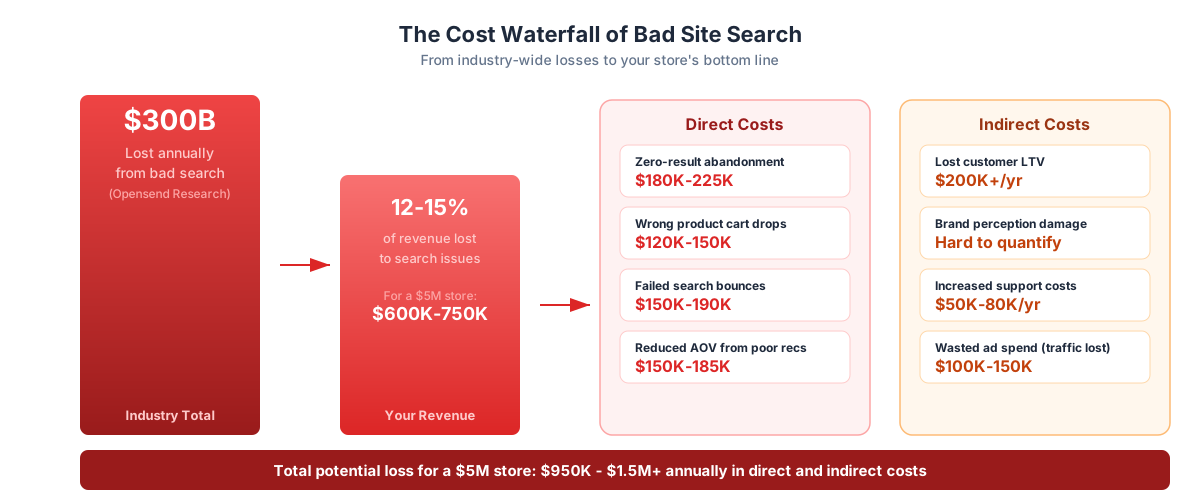
Direct Costs: The Revenue You Can Measure
Direct costs are the sales you lose right now, today, because search fails. These are calculable from your existing analytics if you know where to look.
Zero-Result Abandonment
Every time your search returns "No results found," you've created a dead end for a high-intent shopper. Baymard Institute research confirms what behavioral data shows: shoppers who hit zero results don't try again. 80% leave the site entirely. If this is where your search bleeds the most, our guide on how to fix zero-result searches walks through the fixes.
How to calculate your cost:
Take your monthly search queries. Multiply by your zero-result rate (check your search analytics - the average is 10-15%, but some stores are as high as 25%). Multiply by 80% (the percentage who leave). Multiply by your search conversion rate. Multiply by your average order value.
Example for a store with 100,000 monthly visitors:
- 15,000 use search (15%)
- 2,250 hit zero results (15% zero-result rate)
- 1,800 leave the site (80%)
- 81 would have converted (4.5% search conversion rate)
- $6,885 lost per month (at $85 AOV)
- $82,620 lost per year - just from zero-result pages
Failed Search Bounces
Zero results aren't the only search failure. Irrelevant results are almost as bad. When someone searches "red dress for cocktail party" and gets a mix of red kitchen towels, dress shirts, and cocktail glasses, they bounce just as fast as if they'd seen zero results.
Irrelevant results are actually harder to measure because your search technically "returned results" - they just weren't useful. The signal to watch: search exit rate. If more than 30% of search users leave the site directly from the search results page, your relevance is broken.
Typical cost: Similar to zero-result abandonment. For our example store, another $5,000-8,000 per month.
Wrong Product Cart Abandonment
This one is sneaky. Search returns results that are close-but-not-right. The shopper clicks through, maybe even adds to cart, but during the checkout process realizes it's not what they wanted. They abandon the cart.
You see this in your analytics as cart abandonment, but the root cause was search returning the wrong product in the first place. If the shopper had found the right product from their search, they'd have completed the purchase.
Typical cost: 2-4% of total cart abandonment can be attributed to search-driven wrong-product adds. For our example store, that's $3,000-5,000 per month.
Reduced Average Order Value
Good search doesn't just help shoppers find what they're looking for - it surfaces complementary products, alternatives at different price points, and options the shopper didn't know existed. Bad search surfaces nothing useful, so the shopper buys the first acceptable thing they find (or nothing at all).
Stores with optimized search consistently report 15-25% higher AOV among search users compared to stores with basic keyword search. The difference? AI search that understands "I need a complete outfit for a job interview" can show a coordinated set of products, while keyword search shows one item at a time.
Typical cost: For our example store, the AOV difference between optimized and unoptimized search translates to roughly $4,000-6,000 per month in missed upsell and cross-sell revenue.
Indirect Costs: The Revenue You Can't Easily Measure (But It's Real)
Direct costs are painful enough. But the indirect costs of bad search are often 2-3x larger - they're just harder to attribute.
Customer Lifetime Value Erosion
A single failed search experience reduces return visit likelihood by 60%. Think about that. Not 5%. Not 10%. Sixty percent.
If your average customer lifetime value is $200, and a bad search experience reduces the probability of a customer returning from 40% to 16%, you've destroyed $48 in future value per failed search interaction. Multiply that by thousands of failed searches per month and the numbers get very large, very fast.
For our example store: If 4,000 shoppers per month have a poor search experience and each loses $48 in expected future value, that's $192,000 in annual lifetime value destruction. This is the cost that nobody measures but everybody pays.
Brand Perception Damage
Shoppers who experience search failure rate the overall store experience 40% lower than shoppers who find what they're looking for. They don't compartmentalize. They don't think "great products, bad search." They think "bad store."
This manifests as:
- Lower Net Promoter Scores
- Fewer word-of-mouth referrals
- Lower social media mentions
- Reduced organic review volume
You can't put a precise dollar figure on brand damage, but the compounding effect over months and years is substantial. Every negative search experience is a tiny erosion of the brand equity you've spent years building.
Increased Customer Support Costs
When search fails, some shoppers don't just leave - they contact support. "I'm looking for X but I can't find it on your site." These are actual conversations that your team has to handle, often for products you absolutely stock but that search couldn't surface.
Every one of these support interactions costs $5-15 in labor. For stores with high search failure rates, "help me find a product" queries can represent 15-25% of total support volume.
For our example store: If 300 shoppers per month contact support because search failed, at $10 per interaction, that's $36,000 per year in support costs directly caused by bad search.
Wasted Advertising Spend
This is the one that should make marketing teams angry. You're spending money - on Google Ads, Meta campaigns, email marketing, influencer partnerships - to bring people to your store. You're paying $2, $5, $10 per visitor to get them through the door.
And then your search bar sends them away.
If 15% of your paid traffic uses search and 30% of those searches fail, you're wasting 4.5% of your total advertising budget on visitors who bounce because of search. For a store spending $200,000 per year on advertising, that's $9,000 wasted. For stores spending $1M+, it's $45,000+.
You would never intentionally run ads that lead to a broken page. But a broken search experience is effectively the same thing.
!Search revenue impact calculator
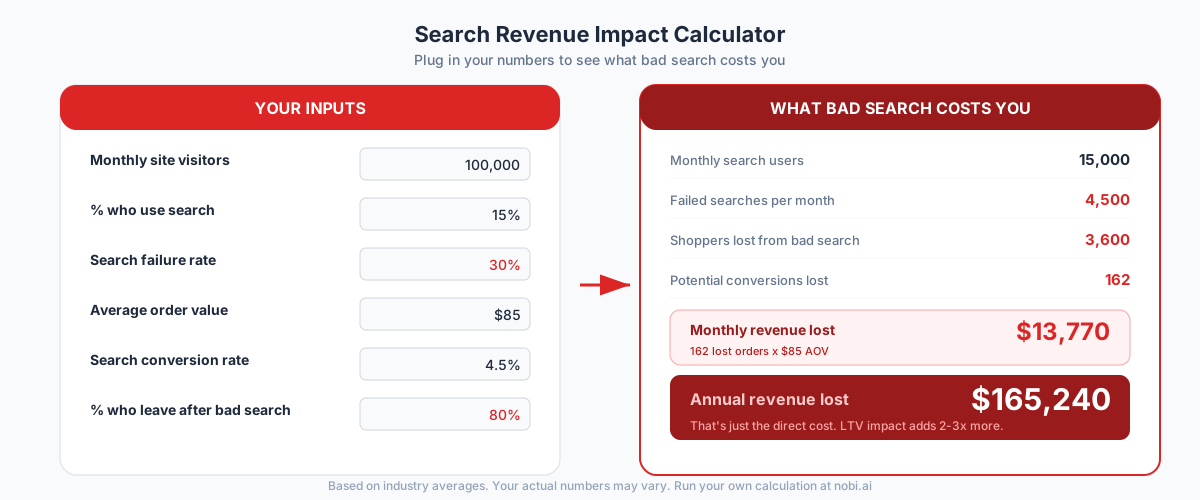
The Calculator: What Bad Search Costs Your Store
Let's bring all of this together. Here's a simplified calculator for a store with 100,000 monthly visitors, $85 AOV, and 15% search usage:
Direct costs (monthly):
- Zero-result abandonment: $6,885
- Irrelevant result bounces: $6,500
- Wrong-product cart abandonment: $4,000
- Reduced AOV: $5,000
- Total direct: $22,385/month ($268,620/year)
Indirect costs (annual):
- Customer lifetime value erosion: $192,000
- Support cost increase: $36,000
- Wasted ad spend: $18,000
- Brand perception (estimated): $50,000+
- Total indirect: $296,000+/year
Combined annual cost: $564,620+
For a store doing $5 million in annual revenue, that's over 11% of total revenue lost to bad search. And this is a conservative estimate - many stores have worse zero-result rates, higher failure rates, and more expensive acquisition costs.
The Math That Should End the Debate
The cost of fixing search is measured in hundreds or low thousands of dollars per month. The cost of not fixing it is measured in hundreds of thousands per year.
Enterprise solutions like Constructor ($50K+/year) or Bloomreach (enterprise pricing) have historically priced out smaller brands. If those quotes are what's stalling you, it's worth reviewing the best Constructor alternatives for ecommerce. But AI-powered solutions like Nobi make smart search accessible at a fraction of the cost.
Let's do the ROI math. If implementing AI search costs $X per month and recovers even 20% of your search-related losses, you're looking at:
- 20% of $22,385 monthly direct losses = $4,477/month recovered
- Plus downstream lifetime value recovery
- Plus reduced support costs
- Plus better ad efficiency
Even conservative estimates put the ROI at 3-10x within the first quarter. This isn't an optimization. It's plugging a hole in your bucket.
Three Steps to Stop the Bleeding
1. Measure your actual search failure rate. Pull your search analytics. Look at zero-result rate, search exit rate, and search bounce rate. If you can't find these numbers, that's itself a problem - you can't fix what you don't measure.
2. Calculate your specific cost. Use the framework above with your real numbers. Showing leadership the actual dollar cost of bad search is usually enough to prioritize fixing it.
3. Evaluate AI search solutions. The technology exists. It's affordable. It typically pays for itself in the first month. The only question is how much revenue you want to keep losing while you deliberate.
For the tactical side of fixing search, check out our guide on how to increase conversion rate through better search. And to understand how your search compares to what shoppers actually expect, read what shoppers want from site search.
The $300 billion lost to bad search every year isn't an abstract industry problem. It's your problem, measurable in your analytics, fixable with today's technology. The only cost that matters now is the cost of waiting.
FAQ
{meta.faqItems.map((item, index) => ( <details key={index}> <summary>{item.question}</summary> <p>{item.answer}</p> </details> ))}